Roof Damage Insurance Claim - We Force Full Roof Replacement.
Insurance companies patch roofs when they should replace them. Claim Guardians documents structural failure and forces your insurer to pay for a proper, code-compliant replacement. You pay nothing upfront.
Insurers Offer Patches Instead of Replacements.
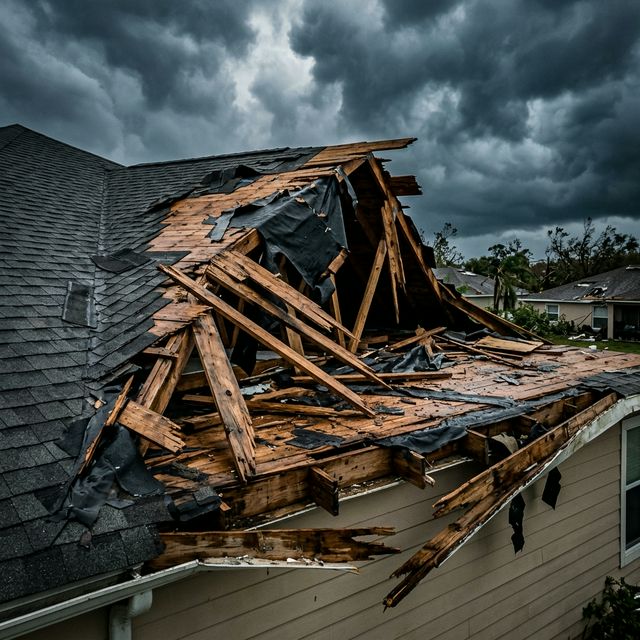
Insurance adjusters classify roof damage as "minor" to avoid paying for a full replacement. They ignore shingle granule loss, decking damage, and structural weakening that compromises your home's integrity.
✓ Claim Guardians Documents the Full Extent.
- 🏠We inspect decking, underlayment, flashing, and gutters.
- 📐We apply Florida building code upgrades to your claim (Code Upgrade Coverage).
- ⚖️We force your insurer to pay for a code-compliant full replacement.
What Does Roof Insurance Cover in Florida?
Florida homeowners policies cover roof damage from covered perils like wind, hail, and fallen objects. But insurers use every tactic to avoid paying for a full replacement.
Wind & Hail Damage
Missing shingles, granule loss, lifted flashing, and cracked tiles from storms. Your insurer must cover repairs or full replacement when wind or hail compromises your roof system.
Fallen Trees & Debris
Trees and large debris that impact your roof during storms. Your policy covers both removal costs and structural repairs to decking, trusses, and shingles.
Resulting Water Damage
When a damaged roof allows water intrusion, your policy covers interior damage to ceilings, walls, insulation, and flooring. Claim Guardians documents the full chain from roof breach to interior loss.
Code Upgrade Coverage
Florida's 25% rule requires a full roof replacement when more than 25% of the roof is damaged. Your insurer must pay to bring the entire roof up to current Florida Building Code standards.
Structural Decking
Plywood decking and underlayment that has rotted or weakened from storm exposure. Insurance adjusters often inspect only the shingle layer and miss critical structural damage below.
Gutters & Flashing
Storm-damaged gutters, downspouts, flashing, and ridge vents are part of your roof system. These components are often excluded from initial insurance estimates.
Our Roof Damage Claims Process
Free Roof Inspection
We climb on your roof and inspect every component: shingles, decking, underlayment, flashing, gutters, and ridge vents. We use drone photography for steep or inaccessible sections.
Damage Documentation
We photograph and measure all damage points. When structural compromise is suspected, we commission an independent engineering report to prove the roof cannot be repaired.
Scope & Estimate
We prepare a detailed scope of loss using Xactimate software and licensed contractor estimates. We include code upgrade costs required under Florida's 25% rule.
Full Replacement Settlement
We negotiate directly with your insurer for a full roof replacement. If they push back, we escalate through appraisal or connect you with a property damage attorney.
We Turn Denied Claims into Full Replacements.
Action Taken
We documented hidden structural roof damage the insurer's adjuster failed to report. The denied claim became a complete roof replacement settlement.
Claim Value Estimator
See how much more you could recover with a Public Adjuster.
Disclaimer: This is an estimate based on historical public adjuster data in Florida, not a guarantee of payout. Final settlement depends on policy limits and documented damage.
Frequently Asked Questions About Roof Damage Claims
Does homeowners insurance cover roof replacement in Florida?
How do I know if my roof damage is covered by insurance?
Can insurance deny a roof claim in Florida?
What is the 25% rule for roof replacement in Florida?
How much does a roof damage public adjuster cost?
Roof Damage Often Leads to Other Claims
Water Damage Claims
A compromised roof lets water intrude into ceilings, walls, and insulation. We recover these secondary losses.
Hurricane Damage Claims
Hurricanes cause the most severe roof damage in Florida. We handle the full scope of storm claims.
Mold Damage Claims
Roof leaks create the moisture conditions mold needs to grow. We prove the causal link for coverage.